U.S. energy demand is surging due to three key drivers: the rapid growth of AI infrastructure,...
From Generation to Retirement: Who Uses RECs and Why It Matters
Renewable Energy Certificates (RECs) serve as more than just records of clean electricity. They underpin an interconnected marketplace of power producers, brokers, corporations, government entities, and registries. Each stakeholder plays a distinct role in the creation, transfer, and retirement of RECs. In this overview from Innovo, we’ll examine the key participants in the REC market and how they shape each stage of the certificate lifecycle. Understanding who participates in the REC market clarifies not only how clean energy is verified, but also how capital flows to build more of it.
What does a REC represent?
Every Renewable Energy Certificate (REC) represents a verified one megawatt-hour (MWh) of renewable electricity delivered to the electric grid. More than a compliance instrument, a REC is the digital proof that clean power was not only generated but authenticated, tracked, and used exclusively once. Each REC provides transparent, auditable evidence of renewable electricity consumption and GHG reduction, underpinning both regulatory reporting and voluntary sustainability commitments in corporate net-zero strategies.
RECs follow a well-defined lifecycle that ensures environmental claims are credible: they are issued when renewable energy is produced, tracked as they are bought and sold through intermediaries and marketplaces, and ultimately retired by the purchasing entity to substantiate the use of renewable energy. Understanding who touches each stage reveals how this market keeps growing, and why it’s foundational to the energy transition.
Who creates RECs?
Power producers: These entities (ex: solar farms, wind projects) generate renewable electricity, and for every megawatt-hour (MWh) delivered to the grid, a single REC is issued. Each REC encapsulates the environmental benefit associated with that specific unit of renewable generation, certifying both its origin and its impact. The issuance and tracking of these certificates are managed by regional registries, which serve as official systems of record and ensure that every REC is counted exactly once.
Producers typically sell RECs alongside electricity through Power Purchase Agreements (PPAs) or separately in unbundled transactions. This additional income is essential for many projects, strengthening the business case for investment in new clean generation assets by making them more attractive to financiers and project backers.
Utilities: Utilities are key players at both the origination and retirement stages. When they generate renewable electricity or procure it from other suppliers, they create or acquire RECs accordingly. Many utilities also run green-tariff and green-pricing programs that let customers voluntarily match their electricity use with REC-backed generation. These aggregated certificates demonstrate regulatory compliance while enabling voluntary participation, helping to decarbonize the grid at scale
How are RECs transferred between users?
Once issued, RECs enter the secondary market, where a network of brokers, trading desks, and aggregators drives liquidity and facilitates price discovery. These intermediaries connect renewable energy producers, utilities, and buyers, enabling a broader range of participants to access supply and meet specific procurement needs.
This middle layer overcomes regional and regulatory barriers to serve both compliance and voluntary buyers by aligning certificates from diverse geographies and technologies. As brokerage functions evolve, digital marketplaces have emerged to expand access, enhance transaction speed, and provide audit-ready transparency.
Innovative platforms now allow buyers to evaluate RECs based on vintage, project location, technology type, and environmental attributes, supporting traceability, risk management, and responsible sourcing. By digitizing these intermediary steps, modern marketplaces reduce friction, standardize verification, and allow buyers to trace renewable energy sources with precision.
Who buys and retires RECs?
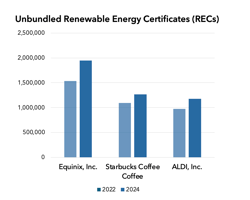
Corporations: Rapidly becoming the primary drivers of REC demand on a global scale, corporates use RECs to advance both regulatory and voluntary sustainability objectives. Leading innovators set the standard by purchasing and retiring substantial volumes of RECs, even when policy mandates slow. They voluntarily purchase RECs to meet standards like the RE100 or GHG Protocol, reducing Scope 2 emissions. Their procurement strategies reflect differing operational priorities: some organizations favor unbundled RECs for maximum flexibility and cost optimization, while others enter into long-term Power Purchase Agreements (PPAs) or Virtual PPAs (VPPAs), securing bundled RECs from specific renewable projects to support traceable, additional impact.
Utilities: REC acquisition is both a regulatory imperative and a customer engagement tool. By purchasing RECs, utilities satisfy compliance obligations dictated by state-level Renewable Portfolio Standards (RPS) or Clean Energy Standards (CES), ensuring that legally mandated thresholds for renewable procurement are met.
Governments and municipalities: The procurement of RECs from these entities are crucial in advancing public-sector sustainability commitments. By purchasing and retiring RECs at scale, these entities can credibly claim renewable use for facilities and public infrastructure, fulfilling ambitious policy targets such as carbon neutrality, or transitioning toward 100% renewable electricity across their operations.
Businesses: More than large corporations procure RECs. Any company with a large energy footprint, or the social motivation to procure renewable energy, can integrate RECs as an operational risk-management and sustainability reporting tool. Through REC purchases, these businesses not only validate progress toward ESG and net-zero commitments but also hedge against volatility in wholesale electricity markets, supporting cost predictability and long-term procurement resilience.
Individuals: Households and small businesses also have pathways to participate in the green energy transition. RECs available through retail electricity providers or dedicated online marketplaces offer consumers the ability to offset their energy use and direct capital toward new renewable project development, regardless of their onsite generation capabilities or access to distributed solar.
Together, these diverse buyer segments activate demand for RECs, driving investment in new renewable generation and supporting a robust, accountable, and transparent clean energy market.
Who supports the REC ecosystem?
Every REC transaction is anchored by a robust network of verification systems that safeguard accuracy and mitigate any risk of double counting. Registries serve as the official source of record, with ten principal systems operating throughout the U.S. and Canada (including WREGIS, M-RETS, PJM-GATS, NEPOOL-GIS, and NYGATS) tracking each REC’s issuance, transfer, and retirement.
Internationally, platforms such as Evident administer I-RECs in more than 50 countries, adhering to the International Attribute Tracking Standard to enable reliable documentation of renewable energy use even where domestic REC frameworks are absent.
While registries maintain integrity within their respective regions, the next evolution lies in interoperability, connecting these fragmented systems through shared data and automated workflow. To unify these fragmented markets, digital marketplaces and innovative software platforms provide integrated platforms that connect buyers to major U.S. registries. Innovo’s solution enhances transparency by delivering real-time insights into project origin, technology, and carbon intensity, supporting comprehensive verification, traceability, and compliance across the entire REC lifecycle.
How does the lifecycle connect?
A REC’s journey mirrors the renewable electricity it represents:
-
Generated by a renewable project.
-
Issued by a registry.
-
Traded through brokers or marketplaces.
-
Purchased by a company, utility, or individual.
-
Retired to substantiate a renewable electricity claim.
At each step, different participants add value. From production to price discovery to data integrity, RECs make the clean-energy market verifiable and scalable.
RECs are the operational infrastructure of clean energy credibility
RECs are the connective tissue of clean energy procurement. They align producers, utilities, corporations, governments, and end consumers around measurable progress toward decarbonization, ensuring that each unit of renewable energy delivered to the grid is reliably tracked, authenticated, and accounted for only once.
This end-to-end traceability is fundamental for both regulatory compliance and the credibility required by voluntary sustainability claims. By digitizing this lifecycle and unifying the data behind it, Innovo helps every market participant, from project developer to corporate buyer, transact faster, report with confidence, and strengthen the credibility of their clean energy claims.
This unification enables developers, utilities, brokers, sustainability leaders, and procurement professionals to transact more efficiently, reduce settlement cycles, and access enriched project and environmental data. As a result, organizations can report progress with greater accuracy, strengthen the integrity of their disclosures, and confidently meet evolving decarbonization targets while driving capital toward new renewable generation.